Why the Live Format Gets Distribution When Your Uploads Do Not
There is a message I get more often than any other, and it always arrives late at night. Some version of: I am publishing consistently, the channel has stopped moving, views are falling, and I do not know what else to do.
I know that feeling well enough. When a channel loses distribution – when the system stops putting your videos in front of anyone – every new upload feels like dropping a stone down a well and never hearing it land. You are still working. Nothing is coming back.
The route I most often suggest in that situation is live streaming. Before anyone copies the tactic, though, I would rather explain why it works, because a method you understand is one you can adapt when circumstances change. A method you copied is one you abandon the moment it stops producing.
What is actually happening when a channel goes quiet
A recommendation system is continuously making a small bet about every piece of content: is this worth showing to more people? It answers that with whatever evidence it has – how long people stayed, whether they engaged, what happened after they finished.
When a channel goes quiet, that bet has been coming back negative for a while. Not necessarily because your content became bad. Sometimes the subject drifted, sometimes the audience the packaging attracted was never the right one, sometimes the format stopped fitting where it was being shown. Whatever the cause, the system now has very little reason to spend impressions on you.
Anything that pulls a channel out of that state has to do one thing: give the system fresh evidence worth reacting to. That is the frame worth holding on to, and it is what makes live streaming interesting.
Three reasons the live format currently gets distribution
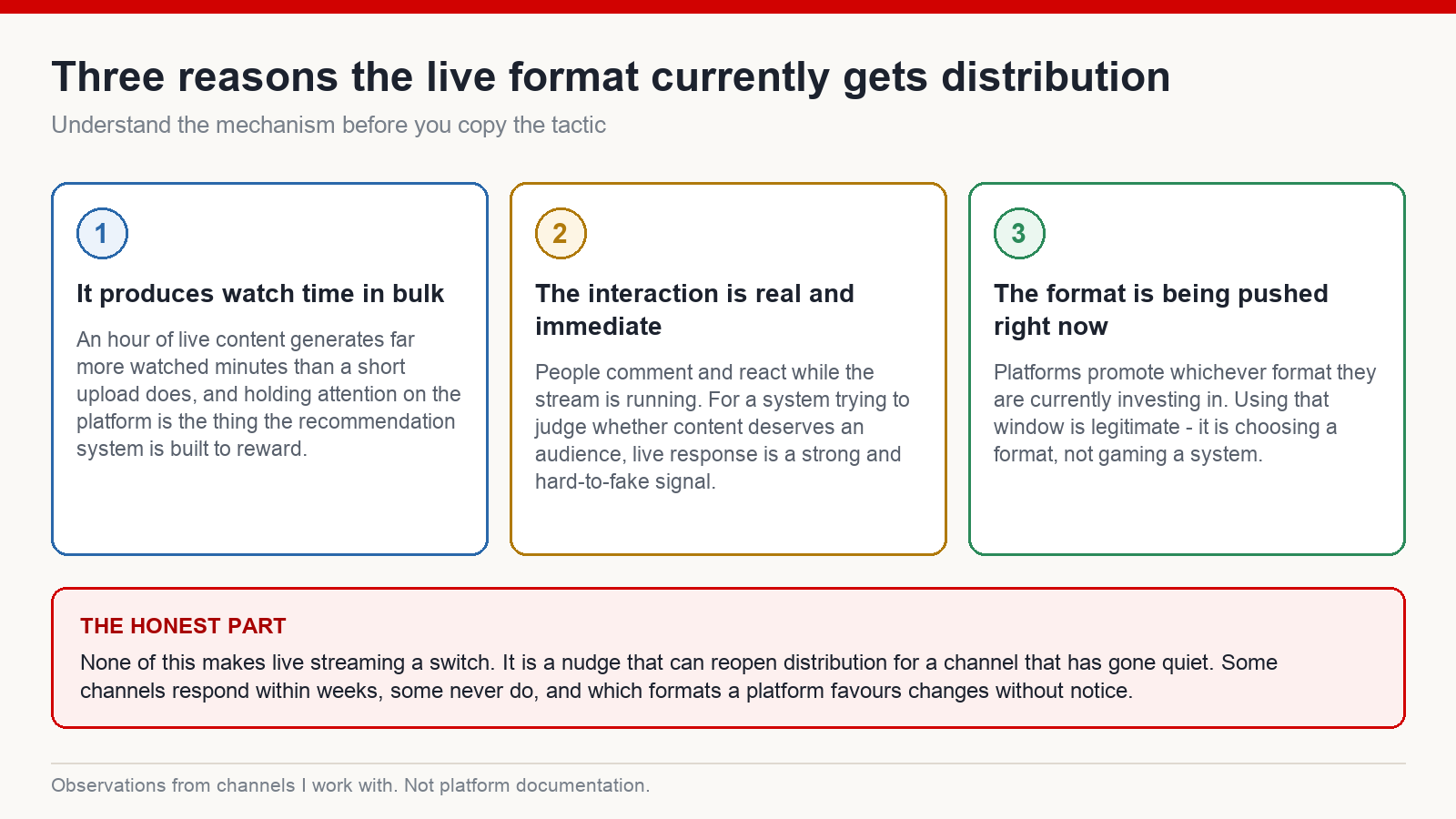
One: it produces watched minutes in bulk
An hour-long stream generates far more watched minutes than a short upload can, simply by existing. And keeping people on the platform is the outcome the whole recommendation machine is built around – not views, which are just the mechanism by which time gets spent.
This is the least glamorous of the three reasons and probably the most important. Length by itself is not virtue. But a format that naturally holds attention for extended stretches is producing exactly the signal the system is most interested in.
Two: the interaction is real and immediate
People comment while a stream is running. They react to something as it happens. That is a materially different kind of engagement from a comment left three days after publication.
For a system trying to work out whether content deserves a wider audience, live response is a strong signal and an awkward one to counterfeit. Content that people are reacting to in the moment is, statistically speaking, content that is holding attention.
Three: it is a format the platform is currently pushing
This is the reason people are most uncomfortable with, and it should not be. Every platform actively promotes whichever format it is investing in at that moment. It happened with vertical clips. It has happened repeatedly with new features. It is happening with live right now.
Choosing to work in a format the platform wants more of is not gaming anything. It is reading the room. The content still has to be yours and it still has to be good – you are simply choosing the door that is currently open rather than the one that is currently shut.
The mechanism, in one sentence
Live streaming produces three things at once – extended watch time, genuine real-time interaction, and participation in a promoted format – and that combination is unusually good at giving the system a reason to look at a channel again.
The practical version I use: you prepare a brand new video, made properly and entirely your own, and you deliver it to the channel as a live broadcast through an encoder or a legitimate streaming service. You get the distribution characteristics of the live format with the production control of an edited video. Nothing about that is a trick, and none of it involves buying engagement, inflating numbers or working around moderation.
What this does not fix
Now the part that gets left out of most articles about this.
Live streaming treats one specific symptom: a channel that has stopped being distributed. It does not treat a content problem. If the underlying issue is that the videos are not good, or the subject has no audience, or the channel has been publishing something derivative, a stream will not repair any of that. You will have generated a burst of watched minutes attached to content nobody wanted, and you will be back where you started in three weeks.
Before you invest in this, it is worth asking honestly which problem you have. A channel that used to reach people and stopped is a distribution problem, and this is a reasonable response. A channel that never reached anyone may have a different problem entirely, and the answer there is upstream – in the subject, the audience, or the quality of the thing itself.
Read the response against your own history
If you do try it, judge the result against your own channel and nothing else.
Not against a number somebody quoted, not against another creator’s screenshot. Your channel’s last ten pieces of content are the only fair comparison available to you, because they share your niche, your audience and your history. Everything else is noise dressed up as a benchmark.
And give it several weeks. Distribution does not turn back on the afternoon you finish your first stream. Some channels respond over a month or two, some never do, and I would be lying if I told you which yours will be.
The part worth keeping when the tactic expires
Formats rotate. The one being promoted today will be ordinary in two years, and something else will take its place. If all you take from this is that live streaming works, that knowledge has a short shelf life.
The durable version is the principle underneath: platforms reward held attention and real interaction, and they temporarily favour whichever format they are investing in. Whenever you notice a format getting unusual reach, that is worth examining – not because it is a shortcut, but because it tells you where the open door is this year.
Meanwhile the thing that survives every format shift is content people actually want to sit through. Streaming can reopen a door. It cannot make anyone want to walk in.
Frequently asked questions
Does live streaming guarantee my channel recovers?
No, and be suspicious of anyone who tells you otherwise. It is a legitimate nudge that can reopen distribution. Whether a specific channel responds depends on why it went quiet in the first place.
Is streaming a pre-recorded video against the rules?
Delivering pre-recorded content through an encoder is a normal, supported practice, and platforms also offer a premiere feature built for that exact case. What matters is that the content is genuinely yours and the packaging honestly describes it. Rules do get revised, so check the current version where you publish.
How long should a stream be?
Long enough to produce a meaningful amount of watched time – in my own practice, at least half an hour and preferably longer. But a long stream nobody stays for is not an improvement on a short one they do.
Will this work on a brand new channel?
It is designed for a channel that had distribution and lost it. A new channel has a different problem: it has not established what it is or who it is for yet, and no format solves that.
Do I need expensive equipment?
No. Free encoder software and the video you already made are enough. The constraint here is the quality of the content, not the hardware.
Understand it, then decide
Live streaming is worth trying when a channel that used to reach people has stopped. It produces watch time, it produces real interaction, and it currently benefits from being a format the platform wants more of. Those three things together can be enough to get you looked at again.
What it is not is a substitute for content anyone wanted. Be honest with yourself about which problem you are solving, run the experiment patiently, and measure it against your own channel rather than anyone else’s.
If you would rather build a channel that does not need rescuing – starting from the subject and the audience instead of the tactics – that whole process is what I teach at mmoyoutube.com.